
Division 01
Demolition Company in East Sussex, West Sussex, Kent and Nationwide
Full and partial demolition, controlled dismantling and structural take downs, run with our own plant and our own operators. From the first survey to a level site the next trade can work on.
Overview
Demolition, Managed In-House
Our demolition division takes structures down safely and leaves the ground in a state the next trade can actually work on. That runs from a domestic garage or a rear extension through to warehouses, factory units, farm buildings, retail parades, offices and concrete framed blocks. Some jobs are a straight clearance of a whole plot. Others are partial: taking one wing out while the rest of the building stays occupied, forming an opening through a loadbearing wall, or removing a floor slab without disturbing the frame around it.
Clients tend to come to us at one of three points. A developer has bought a site with something standing on it and needs the plot cleared before groundworks and piling can start. A main contractor has a refurbishment where part of the existing structure has to go while the rest stays up, stable and in use. Or an owner has a building that has reached the end of its life, has fire or flood damage, or has moved structurally, and it needs to come down in a controlled way before it comes down on its own.
The approach is the same every time. Work out how the building carries its load, then take that load away in an order that keeps whatever is left standing. In practice that means a structural survey first, a refurbishment and demolition asbestos survey before anyone disturbs the fabric, and a written sequence and method agreed before a machine arrives. Demolition goes wrong when a beam, a wall or a column turns out to be doing more work than the drawings suggested, so nothing gets assumed about what is holding what up.
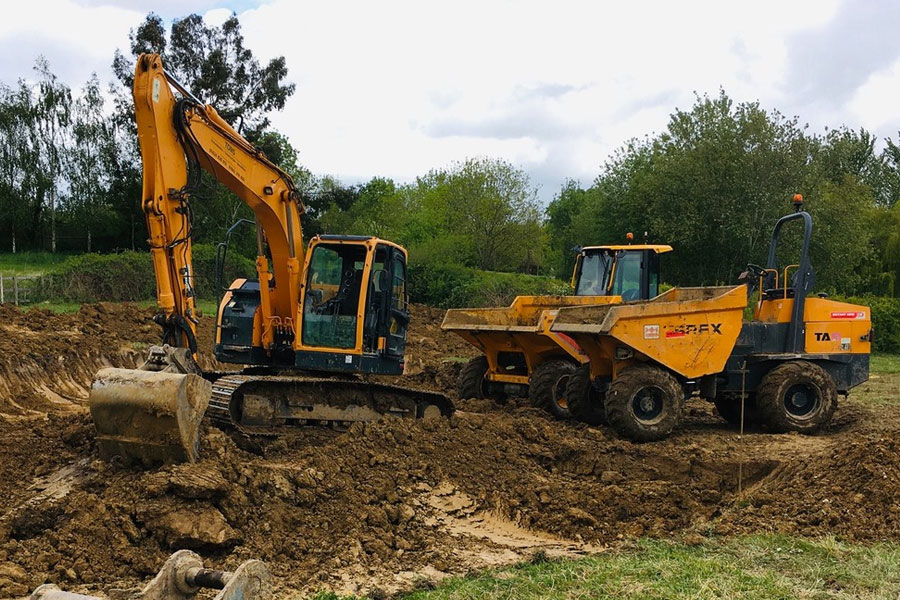
Everything is run in house. Our own excavators and attachments, our own operators, our own lorries taking the arisings away. That matters more on demolition than on almost any other package, because the programme lives or dies on muck away: if the wagons stop, the machine stops and the site fills up. It also means the same team that takes the building down carries on into grubbing out foundations, muck away and groundworks, so there is no gap between packages and no argument about who left what behind.
What we offer
Our Demolition Services
Full Demolition and Site Clearance
Taking an entire structure down to slab or to formation level, including foundations, ground beams, basements, drainage runs, redundant tanks and hardstanding where the brief calls for it. Arisings are removed or processed on site, and the plot is left in the condition you have specified, whether that is a clean level site, a stoned haul route, or ground ready for a piling rig to track onto. If the next trade needs a working platform, that has to be designed and signed off rather than tipped and rolled.
Partial and Structural Demolition
Removing part of a building while the rest stays standing and often stays occupied. This is the work that needs temporary works: props, needles, beams and steel goalposts installed and checked before anything is cut. Typical jobs are taking off upper storeys, removing a rear wing, forming openings through loadbearing masonry, cutting a frame back to a new grid line, or taking out floor slabs while leaving the columns in place. What goes and what stays gets marked up on site, not just on a drawing.
High Reach Demolition
For structures too tall, too fragile or too close to something else to take down from the ground with a standard machine. A long front excavator with shears or a pulveriser on the end lets the operator work at height from the cab at ground level, so nobody is standing on the structure as it comes apart. It also gives better control over where material falls. The exclusion zone is set from the height of the structure and the likely fall of debris, not from the reach of the machine.
Top Down Demolition and Dismantling
Where there is no room to drop material, the building comes apart floor by floor from the roof down. A machine is lifted onto the slab by crane, works its level, then is lowered as each floor goes, with slab loadings checked and backpropping in place before it tracks anywhere. Steel frames are often better unbolted or cut and lifted out in sections than pulled over, particularly where the steel has reuse or resale value and where the neighbours are close.
Asbestos and Other Hazardous Materials
Older buildings routinely contain asbestos in roof sheets, rainwater goods, insulating board, textured coatings, pipe lagging and floor tiles. A refurbishment and demolition survey is arranged first so the material is found on paper rather than by a machine bucket. Licensed removal is carried out by a contractor that holds a licence from the Health and Safety Executive, and demolition of the affected area does not start until clearance has been issued and the certificate is in hand.
Concrete Crushing and Material Recovery
Brick, block and concrete can be crushed and screened on site with a mobile crusher, with a magnet lifting out reinforcement and fixings. The result is a graded recycled aggregate that can go back into the ground as fill, capping or a working platform, subject to testing and the engineer's specification. Crushing on site is a permitted activity in its own right, so the permit position and the end use are agreed before the plant arrives rather than after.
Foundations, Basements and Slab Removal
The part that gets forgotten until the excavator hits it. Strip footings, pad bases, ground beams, pile caps, lift pits, inspection pits, fuel and oil tanks, old cellars and buried slabs all have to come out if the new build needs the ground. We break them out, remove or process the arisings, backfill in compacted layers with material to the specified grade, and record what came out and where it was, which matters once the piling design lands.
Temporary Works and Facade Retention
Where a frontage has to be kept, for planning, for conservation or because it is a party wall, the retained element is tied back into a designed scaffold or steel frame before anything behind it is touched. Propping schemes, needling, raking shores and movement monitoring are designed and checked by a temporary works engineer under the sort of controls BS 5975 sets out, and the demolition sequence is written around the temporary works rather than the other way round.
How we work
How a Demolition Job Runs.
Survey, Asbestos Check and Method
Before anything moves, the structure is surveyed and understood: what is loadbearing, where the beams and columns run, what the floors span onto, how the building has been altered or extended over the years, and what it is attached to. A refurbishment and demolition asbestos survey is arranged so hazardous material is identified up front. Out of that comes the written demolition method and sequence, plus the temporary works needed to keep whatever remains stable at every stage, not just at the end.
Notices, Permits and Disconnections
A section 80 notice under the Building Act 1984 goes to the local authority, and work cannot begin until the council has served its counter notice or six weeks have passed. The planning position has to be squared off as well, whether that is prior approval for the method of demolition and the restoration of the site, or full consent. Party wall notices are served where the Party Wall etc. Act 1996 applies. Gas, electricity, water and telecoms are disconnected by the relevant network and confirmed in writing, and highways, scaffold and skip licences are applied for where the work touches the public realm.
Site Set Up, Protection and Soft Strip
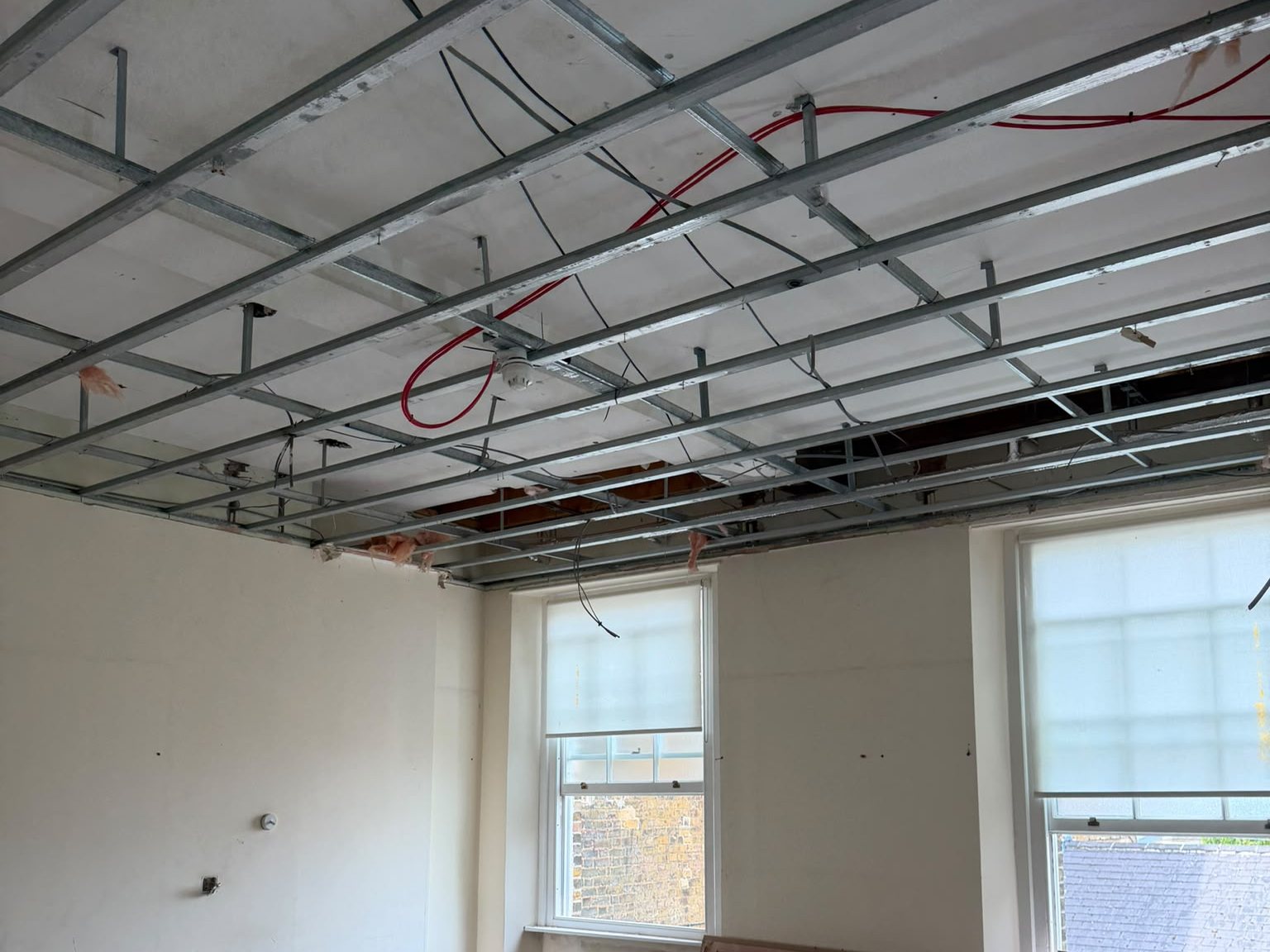
Hoarding, scaffold fans, debris netting and exclusion zones go up, along with welfare, wheel washing and dust monitoring where the site warrants it. Any licensed asbestos removal happens now, under enclosure, with clearance issued before the area is released. Then the soft strip: fittings, ceilings, partitions, glazing, doors, services, plant and anything with reclaim value comes out by hand, so what is left is a bare structure that behaves the way the survey said it would.
Controlled Take Down in Sequence
The building comes apart broadly in the reverse order it went up: roof coverings, roof structure, upper floors, then the frame or the walls, working down. Machine positions, standoff distances and drop zones are set for each stage, with a banksman on the ground and nobody inside the exclusion zone. Water suppression runs while material is being broken and loaded. Where the structure is attached to a neighbour, movement is monitored and the sequence is changed rather than pushed if anything reads differently to the plan.
Grubbing Out, Processing and Levelling
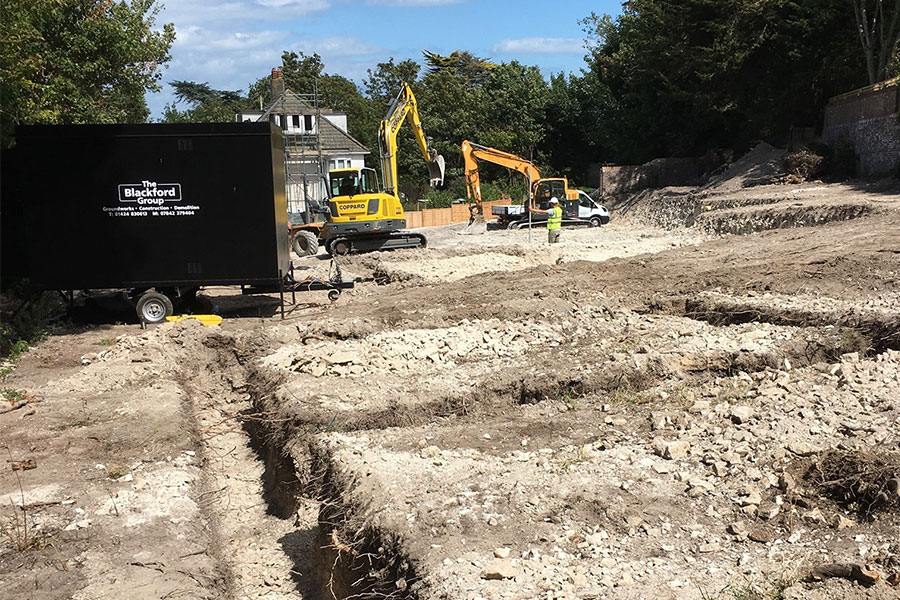
With the superstructure gone, foundations, slabs, ground beams, drainage and tanks come out to the depth the scheme needs. Concrete and masonry are crushed and screened on site where the specification allows, steel and other metals are segregated for recycling, and the rest is loaded out with the waste paperwork that goes with it. The plot is then backfilled, compacted and levelled to formation, and you get the transfer records plus a note of what was removed and where it came from.
Our kit
The Plant We Bring to a Demolition Job.
High reach demolition excavator: a long front machine that lets the operator work at height from ground level, so nobody has to be on the structure while it comes down.
Tracked demolition excavators: the main machines on site, sized to the structure, the access and the reach needed rather than to whatever happens to be free.
Hydraulic shears and pulverisers: shears cut steel sections, rebar and pipework, while pulverisers crush concrete and strip it away from the reinforcement.
Hydraulic breakers: for floor slabs, strip footings, pile caps and mass concrete that will not crack or pull apart under a bucket.
Sorting and selector grabs: pick apart mixed arisings, separate timber, metal and masonry, and load material into wagons without spreading it across the plot.
Mobile crusher and screener: turns brick, block and concrete into graded recycled aggregate on site instead of paying to send it away and buy fill back in.
Dust suppression cannons, bowsers and hose lines: keep airborne dust down during the take down, the crushing and the loading out.
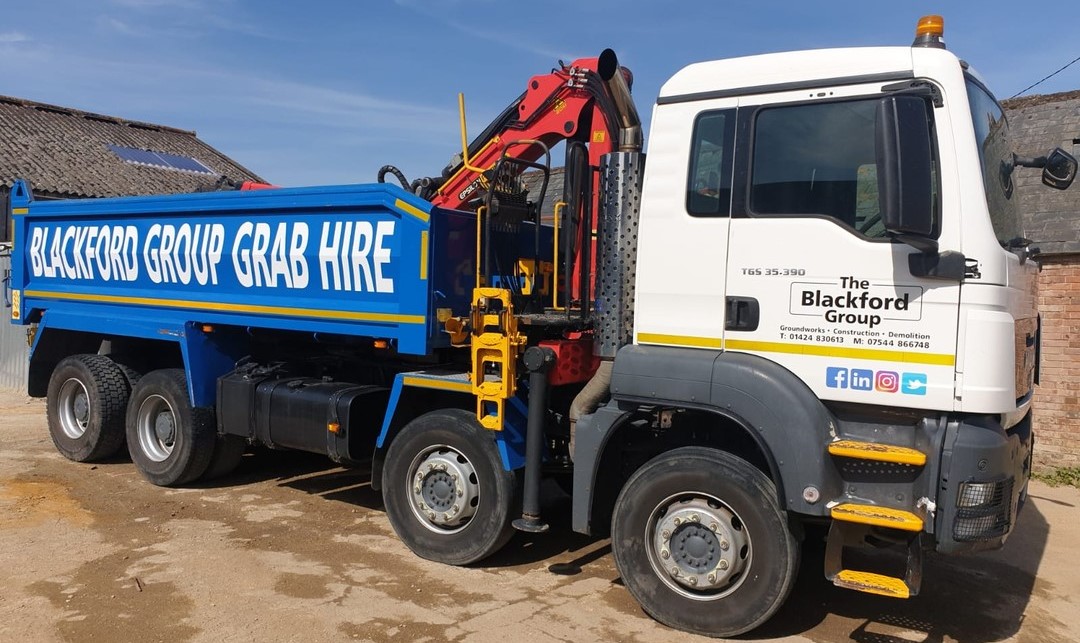
Tippers, grab lorries and low loaders: our own haulage moving arisings off site and bringing plant and attachments on.
Rules and duties
What the Law Asks of This Work.
CDM 2015 and BS 6187
Demolition is high risk work and sits squarely under the Construction (Design and Management) Regulations 2015. That means defined duties for the client, the principal designer and the principal contractor, a construction phase plan in place before work starts, and pre construction information passed to everyone who needs it. Regulation 20 is the one that bites hardest here: the arrangements for demolition or dismantling have to be recorded in writing before that work begins. Where a project runs longer than thirty working days with more than twenty people on site at once, or goes past five hundred person days, the client also has to notify the Health and Safety Executive on form F10. Alongside CDM sits BS 6187, the code of practice for full and partial demolition, which covers how the structure should be surveyed and how the sequence has to keep it stable at every stage. We plan and carry out our demolition work to those requirements, and the written sequence and method goes to the client or principal contractor before we start.
The Control of Asbestos Regulations 2012
Any building put up or refurbished before the year 2000 has to be treated as containing asbestos until a survey says otherwise. The regulations call for a refurbishment and demolition survey, carried out along the lines of HSG264, before demolition or major refurbishment begins. Removal then falls into three groups: work that needs a licence from the Health and Safety Executive, work that needs no licence but has to be notified to the enforcing authority, and work that needs neither. Licensed work covers things like sprayed coatings, pipe lagging and most insulating board. It has to be done by a licence holder, under a notified enclosure, with air testing and a certificate of reoccupation before the area is handed back. We arrange the survey, bring in a licence holder for any material that falls under the licensed category, and keep demolition off that area until the clearance certificate is issued.
Duty of Care for Waste and Hazardous Waste
Everything that leaves a demolition site is controlled waste and carries a legal duty of care under section 34 of the Environmental Protection Act 1990. In plain terms, whoever produces the waste stays responsible for it until it reaches a properly authorised destination. It can only be moved by a carrier registered with the Environment Agency, or the equivalent body in Wales or Scotland, it has to go to a site holding a permit or exemption that covers that material, and every load needs a transfer note describing what is on it. Hazardous material such as asbestos, contaminated soil, oils, fluorescent tubes and some paints and adhesives needs consignment notes and separate handling. Where material is crushed and reused on the same site, that has to sit inside a recognised regulatory position rather than simply being buried. We keep the paperwork for every load and hand the records over at the end of the job.
Who we work for
Demolition for Every Kind of Client.
Commercial
Shops, offices, hotels, pubs, schools and healthcare buildings, usually on tight plots with the public walking past and neighbouring tenants still trading. Most of the effort goes into protecting everything around the job: hoarding and scaffold fans, footway licences from the highways authority, agreed working hours so the noisiest operations do not land at the wrong time of day, dust and vibration monitoring, and party wall matters settled with adjoining owners before anything is touched. Programme certainty tends to matter as much as price, because the following trade is already booked.
Industrial
Factories, warehouses, distribution units, silos, farm buildings and redundant plant. These are often steel or concrete portal frames with asbestos cement roof sheets and cladding, thick reinforced slabs built for forklifts and racking, and buried services, tanks and interceptors that never made it onto a drawing. There is usually real value in the steel and in the crushed concrete, so the sequence is planned to recover it. Contamination from old processes is common, which pulls the remediation and enabling side of the work into the same conversation.
Residential
Single houses, bungalows being cleared for a replacement dwelling, blocks of flats, garages, outbuildings and rear extensions. Domestic jobs are small in tonnage but tight on space and heavy on neighbours, so access, protecting the boundary and keeping the road clean matter more than machine size. Terraces and semis almost always involve a party wall, which means notices, a schedule of condition, and weathering and making good the exposed flank once the structure has gone. For a developer clearing a plot, we take it through to a level site ready for setting out.
On site
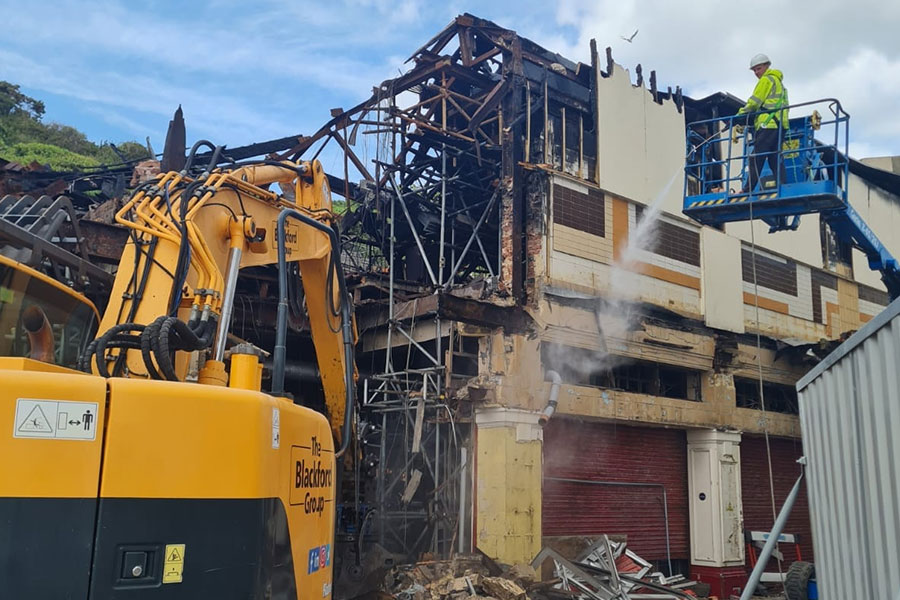
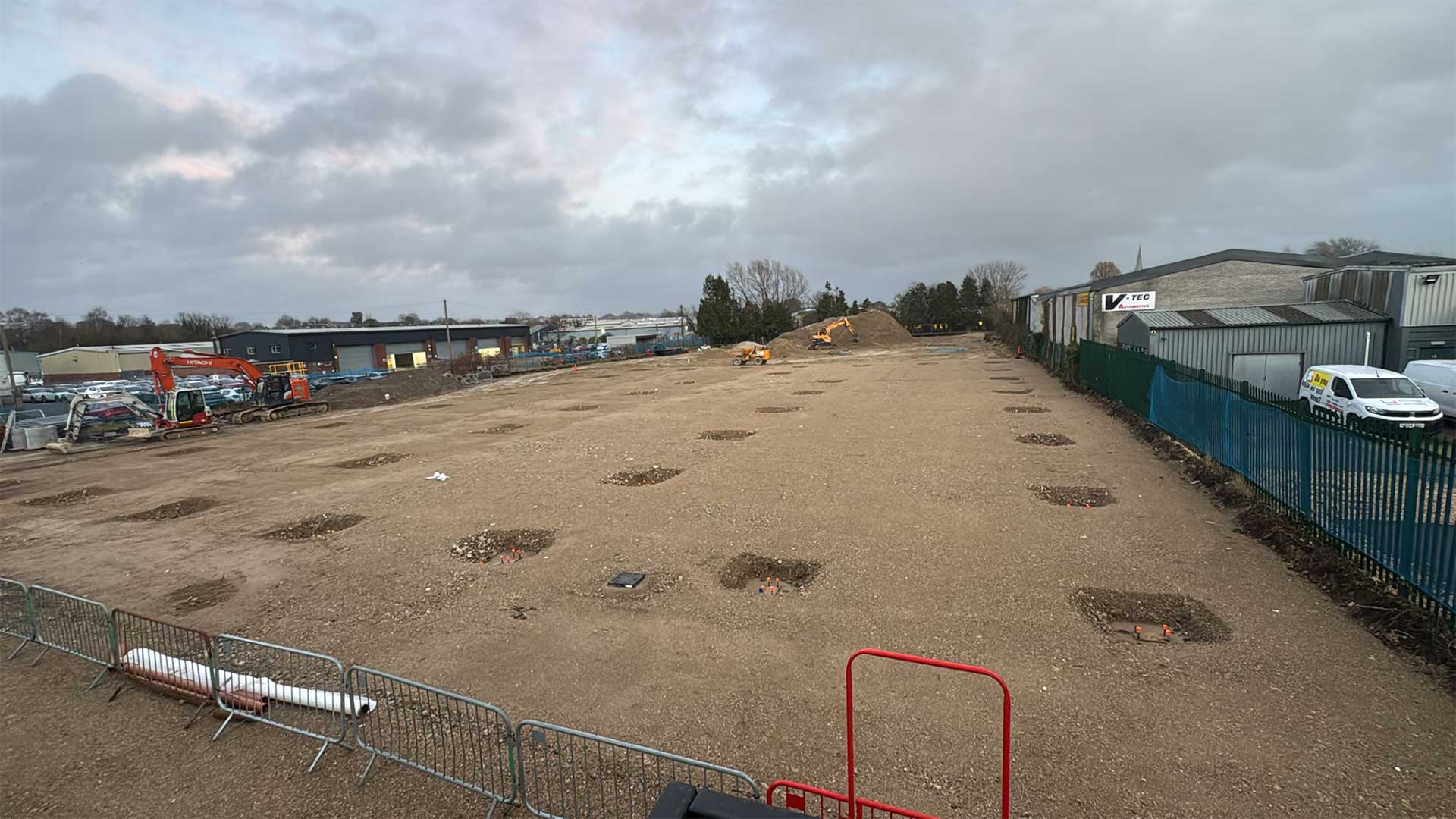
Demolition in Action
FAQs
Demolition Questions
How long does a demolition job take?+
It depends on the structure, the access, how much asbestos is in it and what has to happen to the foundations and slab. A single garage is a short visit. A steel framed industrial unit with an asbestos roof, a heavy slab and crushing on site is a proper programme, and the asbestos removal often sits on the critical path because nothing else can start in that area until clearance is issued. We give you a programme once the building has been surveyed, rather than a date picked to sound good and then missed.
Do I need permission to demolish a building?+
Usually some form of it. Most demolition needs a section 80 notice served on the local authority under the Building Act 1984, and you cannot start until the council has replied or six weeks have passed. Beyond that it varies. A lot of demolition is permitted development subject to prior approval for the method of work and the restoration of the site, but taking down a whole dwellinghouse or a block of flats needs planning permission in its own right, and listed buildings and buildings in conservation areas need consent. We will tell you what we believe applies, but confirm the planning position with the council or your planning consultant before you commit to a date.
What happens if there is asbestos in the building?+
It gets found before work starts, not during. A refurbishment and demolition survey is carried out first, which is intrusive and goes looking in the places a management survey does not. If it turns up licensed material such as pipe lagging, sprayed coating or insulating board, a licence holder removes it under a notified enclosure, with air testing and a certificate of reoccupation at the end. Material that needs no licence, such as cement roof sheets, comes off under controlled conditions, kept whole where possible and wrapped or double bagged. Demolition of that area does not begin until the clearance paperwork is issued.
Where does all the material go?+
As much as possible stays on site or goes back into the supply chain. Brick, block and concrete can be crushed and screened into recycled aggregate for use as fill, capping or a working platform where the engineer's specification allows. Steel, copper, aluminium and other metals are segregated and go for recycling. Timber, plasterboard and general waste are separated and taken to a facility permitted to receive them. Asbestos and other hazardous waste travels under consignment notes to a site authorised to take it. You get the transfer records for every load at the end of the job.
Can you demolish part of a building while the rest stays in use?+
Yes, and a good part of our work is exactly that. It changes how the job is planned rather than whether it can be done. The retained structure is propped, needled or framed before anything is cut, the separation between the working area and the occupied area has to be sealed, fire rated and signed, and services running through the demolition zone are traced and either isolated or diverted first. Noise and vibration are managed around whatever is still going on next door, and the sequence is written around the temporary works design and the hours you can realistically work.
My building is attached to my neighbour's. What happens?+
That brings the Party Wall etc. Act 1996 into play, and notice has to be served on the adjoining owner before work starts, normally two months ahead for work to a party wall. A schedule of condition is usually taken first so there is a record of what their property looked like beforehand, which protects both sides. On site, the exposed flank has to be made good and weathered once your structure has gone: repointing or rendering, insulating and cladding where required, flashing the abutment and dealing with any chimney breast or fireplace left open. It is a normal part of the job and it needs pricing in from the start.
What drives the cost of a demolition job?+
Mainly four things. First, what the building is made of and how much of it there is, because tonnage drives both machine time and wagon movements. Second, asbestos, since licensed removal is a specialist operation with its own enclosure, testing and disposal costs. Third, access and constraints: a plot you can track a machine straight onto is a very different job to a town centre site needing hoarding, licences, restricted hours and a crane. Fourth, how far down you have to go, because grubbing out foundations, basements and slabs can be as big a job as the building above them.
If you have a building to take down, the most useful conversation is usually the one before the design is finished, because how a structure comes apart tends to change what is sensible to build in its place. Send us whatever you have, a full set of drawings and an asbestos survey or just an address and a few photographs on your phone, and we will tell you how we would approach it, what the real constraints are and what it is likely to cost. Call the yard on 01424 830613 or send the details over and we will come and look at it. We work nationwide from Upper Wilting Farm, St Leonards-on-Sea, and because the demolition, the muck away, the enabling works and the groundworks are all our own divisions, one call covers the whole job instead of four.
Need Demolition?
Tell us what you need moving, clearing or building and we will come back with a straight answer and a fair price.