
Division 07
Piling Contractors in East Sussex, West Sussex, Kent and Nationwide
CFA, driven, screw and restricted access piling nationwide, with the pile caps, ground beams and muck away handled by our own teams.
Overview
Piling, Managed In-House
The Blackford Group installs piled foundations nationwide, from mini piling in a back garden to CFA piles under a commercial frame and sheet piled walls holding back a basement dig. Piling is what you use when the ground near the surface will not carry what is going on top of it, so the load has to be taken down through the soft material to something that will hold it: dense sand and gravel, stiff clay or weathered rock. We run the rigs, the operators and the follow on groundworks ourselves, so the piles, the caps and the beams are one job rather than three separate orders.
Most projects reach us for one of a handful of reasons. The site investigation comes back with made ground over soft alluvium and the engineer specifies piles. A plot sits on a former quarry, a filled tip or a riverbank. Mature trees close to the building mean a trench fill footing would have to go far deeper than makes sense in a shrinkable clay. An extension is going up hard against a neighbour's wall and the load has to be taken past it. Or a basement, a tank pit or a deep drainage run needs a wall driven around it before anyone can dig. All of that is piling work, and the right method for each one is different.
We start with the ground, not the rig. Borehole logs, cone penetration or standard penetration test results, groundwater levels and any contamination testing tell us what the pile has to pass through and what it can bear on, and that decides whether the answer is a bored pile, a driven pile, a screw pile or a sheet piled wall. Access matters just as much. A site with two metres of headroom and a 900mm doorway rules out most rigs before the soils are even considered, so the method is chosen around what can physically get in, stand up safely on the platform and still carry the design load.
Piling is also record keeping, and that part gets underestimated. Every pile gets its own record: position, depth, verticality, concrete volume or driving set, cut off level and the date it went in. That record is what the structural engineer checks the design against, what building control asks to see, and what answers a question raised two years later. We write it up as the rig works rather than reconstructing it afterwards, and hand it over with the as built pile layout and any test results once the caps are poured.
What we offer
Our Piling Services
CFA (Continuous Flight Auger) Piling
A hollow stem auger is drilled to design depth in one pass, then concrete is pumped down through the stem under pressure as the auger is withdrawn, so the bore is never left open and unsupported. The reinforcement cage is plunged into the wet concrete straight afterwards. CFA is quiet next to driving and puts very little vibration into the ground, which matters beside occupied buildings, and it copes with cohesive soils and with water bearing sands and gravels where an open bore would collapse. Shaft diameters are sized to the load, commonly from around 300mm upwards.
Restricted Access and Mini Piling
Compact tracked and modular rigs that go through a domestic doorway, work under about two metres of headroom and get into rear gardens, basements and live buildings. The usual methods are bottom driven steel cased piles, where a drop hammer works inside the tube against a dry concrete plug and drives the casing down, and sectional flight auger piles built up in short lengths. Shafts are small, usually in the 150mm to 300mm range, so loads are normally carried on a group of piles under a shared cap rather than one large shaft.
Driven Precast Concrete Piles
Jointed precast concrete sections driven with a hydraulic hammer until the set meets the design criteria. Nothing is excavated, so there are no arisings to cart away and nothing to test and classify on a contaminated plot, and the driving resistance gives a check on every pile against the design as it goes in. Driving does generate noise and ground vibration, so it suits open commercial and industrial plots better than a terrace, and it is assessed and controlled to BS 5228 with monitoring on nearby structures where that is called for.
Screw and Helical Piles
Steel shafts with welded helical plates wound into the ground by a hydraulic torque head on an excavator. Capacity is correlated to the installation torque, so there is a reading on every pile as it goes in, there is no spoil and no concrete to cure, and the pile can take load as soon as it is installed. They suit lightly loaded structures: modular buildings, canopies, walkways, solar frames, signage, fencing and temporary works. Where the structure is not permanent, they can be unwound and reused elsewhere.
Sheet Piling and Embedded Retaining Walls
Interlocking steel sheet piles in U and Z sections, driven with an excavator mounted or crane suspended vibratory hammer to retain an excavation, hold back water or form a permanent wall. Temporary sheets are extracted and taken away once the dig is backfilled. Where vibration would be a problem, sheets can be pressed in hydraulically, using the piles already installed as the reaction. Where a stiffer, deeper or more watertight wall is needed, contiguous and secant bored pile walls and king post walls with infill panels are the alternatives, worked out with the engineer.
Piling on Made Ground and Contaminated Land
Old tips, gasworks sites, filled quarries and riverside plots need the pile designed so it does not create a path for contamination to travel down into the aquifer below. That means a method assessed against the Environment Agency guidance on piling on land affected by contamination, arisings handled and tested as potentially hazardous waste, and the bore, the concrete and any grout kept under control. It gets planned before the rig is booked, not worked out on the day it lands.
Pile Testing and Integrity Checks
Low strain integrity testing across the finished shafts to pick up necking, inclusions or a pile that has come up short, static maintained load testing on preliminary or working piles to prove the design against the specified load, and dynamic testing on driven piles where that is the faster route to the same answer. The number and type of tests come from the specification and the engineer. Results are issued alongside the pile records so the frame is not going up on an assumption.
Cropping, Pile Caps and Ground Beams
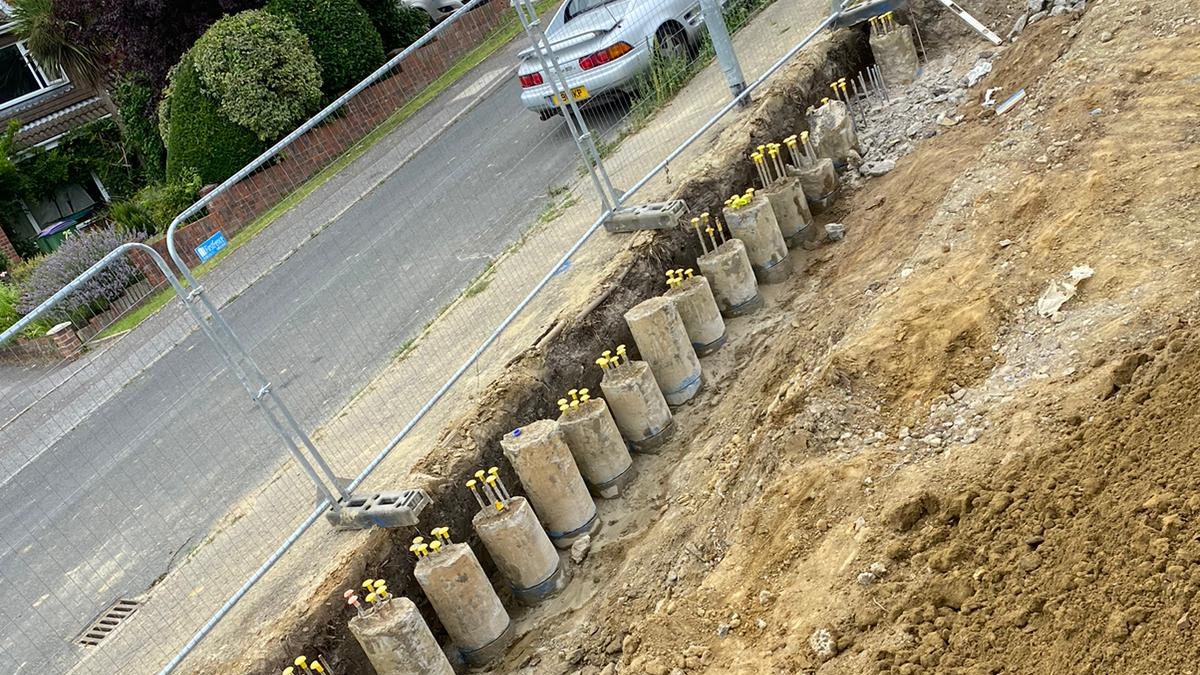
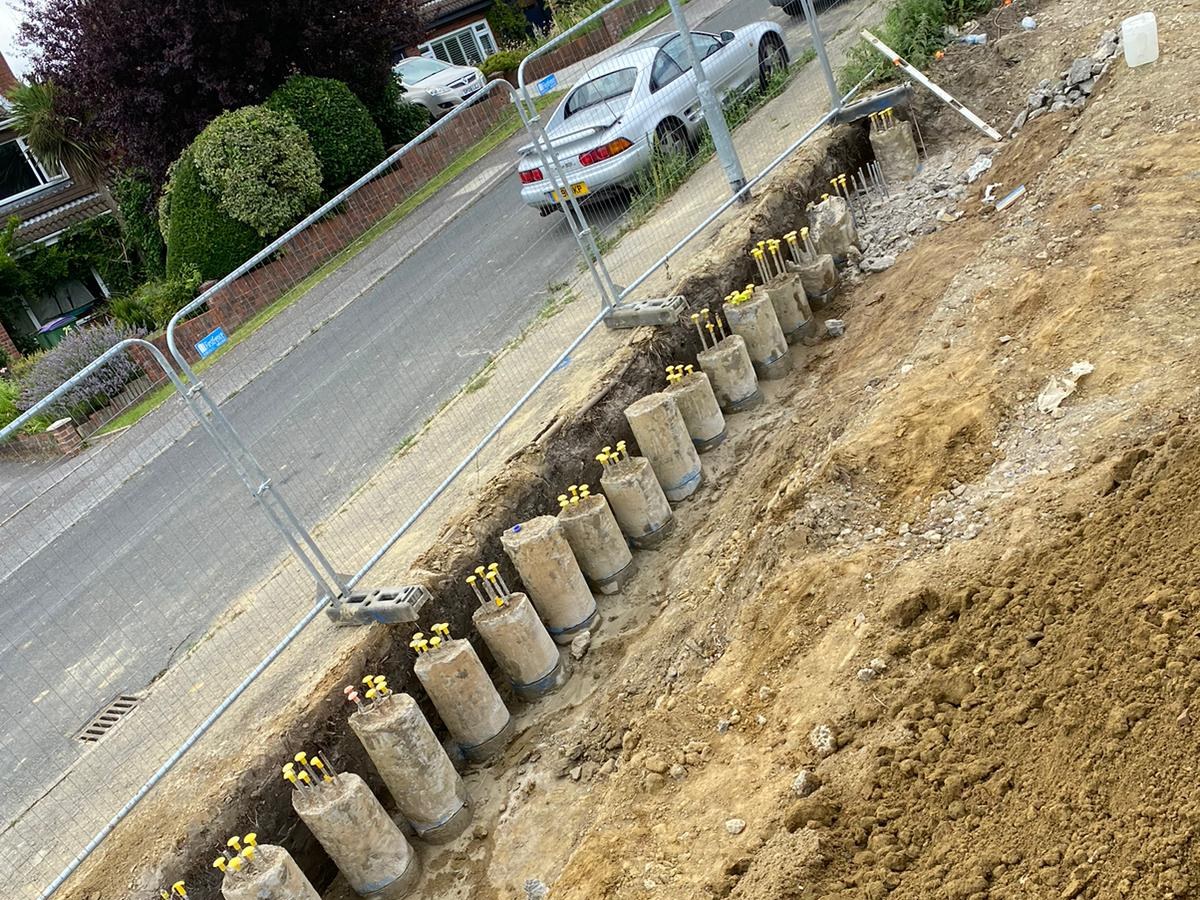
Once the concrete has gained strength the piles are broken down to cut off level with a hydraulic cropper, which takes the shaft off cleanly and leaves the reinforcement intact and at the right length to lap into the cap. From there our groundworks teams carry on with the blinding, the cages, the shuttering and the pours for pile caps, capping beams and ground beams, so the foundation is finished by the same contractor that installed the piles.
How we work
How a Piling Job Runs.
Ground Information and Pile Design
Nothing gets ordered until we have read the site investigation: borehole logs, in situ test results, groundwater levels, sulfate and contamination testing. Those numbers set the bearing stratum, the pile type, the diameter, the depth and the concrete class needed for aggressive ground. Working loads come from the structural engineer, the design is worked to Eurocode 7 with the UK National Annex, and the pile layout drawing, tolerances and cut off levels are agreed before anyone mobilises. If there is no site investigation yet, arranging one is the first job, because the design cannot be done properly without it.
Working Platform, Services and Set Up
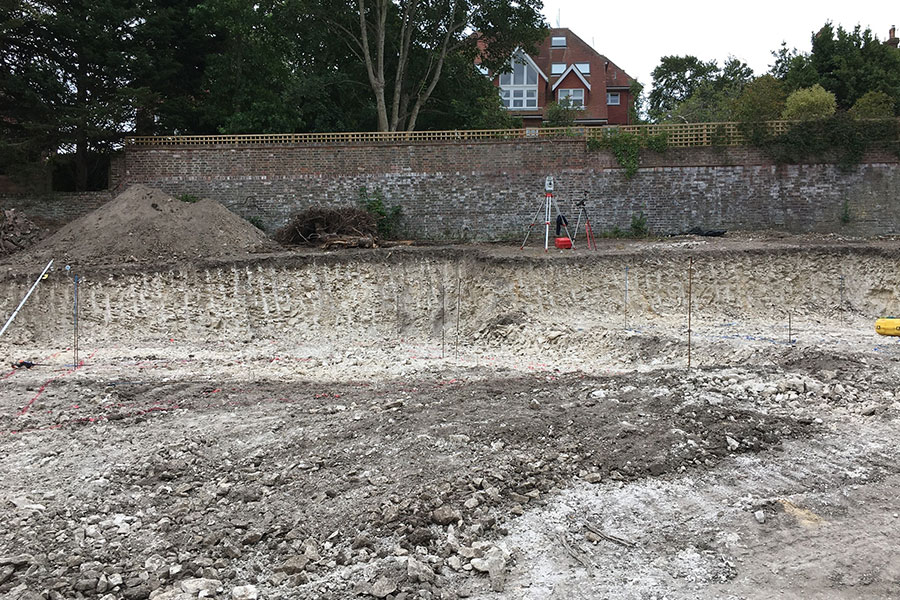
A piling rig is heavy and top heavy and puts high loads through a small track area, so it needs a designed and certified working platform under it: granular, compacted, level and to a stated thickness. Building and certifying that platform is the main contractor or client's duty, so we issue the rig weights, track loadings and configuration early enough for it to be designed, built and signed off. Before the platform goes down, buried services are scanned and proved with hand dug trial holes, overhead lines are dealt with, and the pile positions are set out from the grid and marked.
Installation, Pile by Pile
The rig sets up over each position, verticality is checked on both axes, and the pile is bored, driven or screwed to depth. On CFA work the concrete pump follows the rig and the volume placed in each pile is logged against the theoretical volume, so an overbreak or a loss of concrete shows up immediately rather than at test stage. Cages are lifted in and plunged while the concrete is still workable. Driven piles are taken to the specified set, screw piles to the specified torque. Each pile is written up as it is finished.
Testing and Breaking Down
Concrete is left to gain strength before anything is done to the pile heads. Integrity testing and any static or dynamic load testing happen at the stage and frequency the specification calls for, and results go straight to the engineer so a problem pile can be dealt with before it is buried under a cap. The piles are then cropped down to cut off level with a hydraulic cropper, leaving the reinforcement clean, straight and full length, and the debris is cleared off the pile positions ready for the caps.
Caps, Beams and Handover
Cap and beam excavations are dug, trimmed, blinded and reinforced, the shuttering goes up and the pours go in, with the pile reinforcement lapped into the cap steel. Levels and setting out are checked against the drawing before and after each pour, then backfill goes in and any drainage, ducts or service penetrations through the ground beams are formed. The works are handed over with the as built pile layout, the individual pile records and the test results, so the frame or slab contractor starts from a marked out, level base.
Our kit
The Plant We Bring to a Piling Job.
CFA piling rig with hollow stem auger: bores to depth and delivers concrete through the auger stem in one operation, with instrumentation logging depth, torque and concrete pressure.
Concrete pump and delivery lines: feed the mix from the wagon straight into the auger stem so the pour is continuous and the pile is not interrupted part way down.
Restricted access mini piling rig: compact tracked rig that fits through domestic doorways and works under low headroom for garden, basement and inside building piling.
Bottom driven steel casing system: an internal drop hammer strikes a dry concrete plug in the base of a steel tube to drive it down, used for mini piles and underpinning work.
Excavator mounted vibratory hammer: clamps and drives interlocking sheet piles and steel sections, and pulls temporary sheets back out once the excavation is backfilled.
Hydraulic torque head: excavator mounted drive unit that winds screw and helical piles in while measuring the torque their capacity is checked against.
Hydraulic pile cropper: breaks concrete pile heads down to cut off level cleanly, leaving the reinforcement undamaged and the right length to tie into the cap.
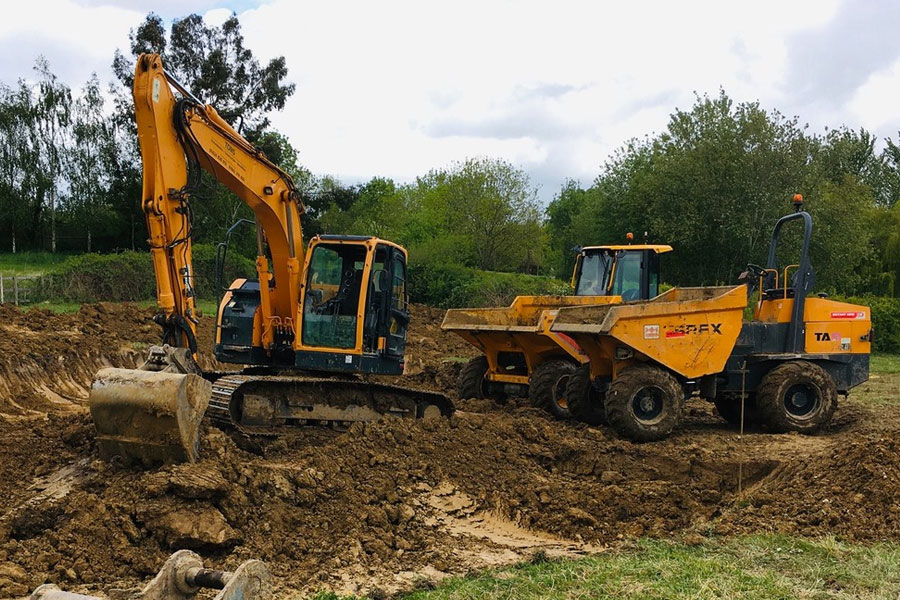
Tracked excavators, dumpers and telehandler: build and maintain the working platform, dig cap and beam excavations, move cages and sheets, and load auger arisings for muck away.
Rules and duties
What the Law Asks of This Work.
CDM 2015, Design Standards and Temporary Works
Piling is construction work, so the Construction (Design and Management) Regulations 2015 apply: pre construction information passed to us, a construction phase plan, a principal designer and a principal contractor appointed wherever more than one contractor is involved, and notification to the HSE on projects that meet the notifiable thresholds. The piles themselves are designed to Eurocode 7 (BS EN 1997) with the UK National Annex and installed to the relevant execution standard: BS EN 1536 for bored piles, BS EN 12699 for driven displacement piles, BS EN 12063 for sheet pile walls and BS EN 14199 for micropiles, with the ICE Specification for Piling and Embedded Retaining Walls usually forming the contract specification. Temporary works, including any retaining scheme and the piling platform, need a design and an independent check by a competent person under BS 5975. We work to those requirements and keep the records that go with them.
Working Platforms, Services and Vibration
Overturning is one of the main risks with a piling rig, and a platform that will not carry the machine is a common cause, so the working platform is designed and certified in line with BRE BR470 and confirmed in writing before a rig tracks on. Buried services are located and proved to HSG47 before an auger turns, and work near overhead lines follows GS6. Noise and vibration are assessed and controlled to BS 5228 parts 1 and 2, the local authority can set limits or grant prior consent under section 61 of the Control of Pollution Act 1974, and building response is judged against BS 7385 where neighbours are close. Where a pile or an excavation goes deeper than a neighbouring foundation and sits within the distances the Party Wall etc. Act 1996 sets out, notices have to be served before work starts. Cage and sheet lifts are planned under LOLER 1998, and the rigs are maintained and operated under PUWER 1998.
Arisings, Contaminated Ground and Water
Bored piling produces spoil, and on a brownfield site that spoil is not clean fill. Waste leaving a site travels under the duty of care in section 34 of the Environmental Protection Act 1990: correctly described and coded, carried by a registered waste carrier, taken to a site permitted to receive it, with transfer or consignment notes retained. Anything classified as hazardous carries extra handling and consignment rules. Material that stays on site can only be reused under the Definition of Waste: Code of Practice or a suitable exemption. Where piles pass through contamination, the design is assessed against Environment Agency guidance on piling and penetrative ground improvement on land affected by contamination, which exists to stop a pile becoming a route down to groundwater. Concrete and grout washout is contained, and any dewatering or discharge needs the right permit or consent first.
Who we work for
Piling for Every Kind of Client.
Commercial and Mixed Use Development
On commercial work the piling usually sits between demolition finishing and the frame starting, so it sets the programme for everything after it. That means CFA piles under framed buildings, apartment blocks and retail units, contiguous or secant walls where a basement or lower ground floor is going in tight to a boundary, and close control of noise and vibration where the site is ringed by occupied offices, shops or flats. Accuracy matters here as much as capacity, because a pile outside tolerance means a redesigned cap and a delay to the steel delivery.
Industrial, Infrastructure and Coastal
Warehouses, distribution units, factories and yards put heavy and concentrated loads into the ground: portal frame stanchions, racking legs, tank and plant bases, crane rails and slabs designed for constant forklift traffic. Piling on these plots is often driven or CFA, working across an open grid where a rig can move quickly and noise is less of a constraint. On coastal and riverside schemes, which run alongside our sea defence division, the work is usually sheet piling for quay walls, revetments and scour protection, planned around tides and the working window they allow.
Residential and Domestic Extensions
Domestic piling is normally one of three situations: an extension going up close to mature trees on shrinkable clay, a plot sitting on made ground or an old garden tip, or a house that has moved and needs its foundations taken deeper. Mini piling is the tool for all three, because the rig can get down the side of a house, into a rear garden or inside the building itself and work under an existing structure. Piles are grouped under caps and tied together with ground beams, and the party wall position with the neighbours is settled before the rig arrives.
On site
Piling in Action
FAQs
Piling Questions
How do I know whether my project needs piling?+
The site investigation usually decides it for you. If the ground near the surface is made up, soft or variable, if there is deep fill or peat, if mature trees are close enough to shrink and swell a clay soil, or if the loads are high and concentrated, a strip or trench fill footing will not work and the engineer will specify piles. If there is no site investigation yet, arranging one is the first step, because nobody can design a pile without knowing what is under the site.
What is the difference between bored and driven piles?+
A bored pile takes soil out and replaces it with concrete, so it is quiet and low vibration, but it produces spoil that has to be tested, classified and carted away. A driven pile displaces the soil instead, so there are no arisings at all and the driving resistance gives a check on each pile as it is installed, but it makes noise and ground vibration that can be a problem in a terrace or next to sensitive equipment. Ground conditions, the neighbours and what happens to the spoil normally make the choice obvious.
Can you pile inside a building or in a back garden?+
Yes, restricted access rigs are built for exactly that. They break down small enough to pass through a standard doorway, work under headroom of around two metres and track over ground protection so floors, drives and lawns survive. The trade off is a smaller shaft, so the load is usually carried by a group of piles under a shared cap rather than one large pile, and the total number of piles goes up compared with an open site.
Will piling damage my neighbour's property?+
It should not, and the method is chosen with that in mind. Bored and screwed piles put very little vibration into the ground, and where sheet piles are needed close to a boundary they can be pressed in hydraulically instead of vibrated. Vibration is assessed and controlled to BS 5228 and judged against BS 7385. Where a pile or excavation goes deeper than the neighbour's foundation and sits close enough for the Party Wall etc. Act 1996 to apply, notices have to be served and a condition survey is normally taken before work starts.
What is a working platform and who is responsible for it?+
It is the compacted granular mat the rig stands and tracks on, and it is a designed structure rather than hardcore tipped and rolled. Piling rigs are heavy, top heavy and unforgiving, and an overturn usually starts with a track punching through. Responsibility sits with the main contractor or the client controlling the site, who has the platform designed, built and signed off on a platform certificate. We supply the rig weights and track loadings it has to be designed for, early enough for that to happen before delivery day.
What happens to the spoil from bored piling?+
Auger arisings come out wet and mixed, and on a brownfield plot they may well be contaminated. They are stockpiled on a sealed area, sampled and classified, then moved off under duty of care paperwork to a site permitted to accept them, with hazardous material consigned separately. Where testing shows the material is suitable and the paperwork allows it, some can be reused on site instead of being carted away. Haulage is handled by our own muck away teams, so the rig is not standing waiting for a grab.
Do you test the piles, and do you do the pile caps as well?+
Yes to both. Integrity testing on the shafts and load testing on preliminary or working piles are carried out at the frequency the specification sets, and the results are issued with the pile records for the engineer to sign off. Once the concrete has gained strength we crop the heads down to cut off level and our groundworks teams continue with the pile caps, capping beams and ground beams, so there is no handover between two contractors at the most awkward point in the job.
If you have a site investigation, a pile layout drawing or simply a plot that will not take a normal footing, send it over and we will tell you what it needs. Our yard is at Upper Wilting Farm, St Leonards-on-Sea, East Sussex TN38 8EG and we work nationwide, so it is worth asking wherever the site is. Call 01424 830613 or send the drawings and the ground report through the contact form, and we will come back with the method we would use, what the working platform has to be designed for, and what the piling involves from set up through to capped and ready for the next trade.
Need Piling?
Tell us what you need moving, clearing or building and we will come back with a straight answer and a fair price.